Sunday, 26 February 2012

Waqar Younis

Waqar Younis Biography


Waqar Younis Maitla (Punjabi: وقار یونس, born 16 November 1971) is a former Pakistani right arm fast bowler in cricket and widely regarded as one of the greatest fast bowlers of all time. To date (2011), he hold the record for the youngest Pakistani Test captain and the third youngest Test captain in history (22 years 15 days).[1]
He was best known in cricket for his ability to reverse swing a cricket ball at high speed . He took 373 Test wickets and 416 One Day International wickets during his career. He is considered to be the best exponent of the swing bowling delivery. Younis has the 2nd best strike rate for any bowler with over 200 Test wickets. He worked as a bowling coach with the national side from 2006 to 2007.
Younis was appointed as the coach of the Pakistan cricket team on 3 March 2010.[2] He resigned as Pakistan's Cricket Coach on 19 August 2011.[3]

Early and personal life


Younis was born in Vehari, Punjab in Pakistan. He was educated in Sadiq Public School in Bahawalpur in Pakistan, the Pakistani College (Pakistan Islamia Higher Secondary School) in Sharjah and the Government College in Vehari. He was raised in Sharjah in the United Arab Emirates, where his father was a contract worker. He returned to Pakistan during his adolescent years and there, he started playing cricket.
He is married to Dr. Faryal Waqar Younis, a Pakistani Australian[4] with a son Azaan Waqar and a daughter Maira Waqar and now lives in Castle Hill in Australia.[5] Younis has also worked as a television sports commentator for the Nine Network in Australia and for Ten Sports in the United Arab Emirates.
[edit]Cricket and coaching career


Younis began his cricket career in Pakistan, playing for several First-class cricket clubs. However he suffered an injury when he had cut and removed his little finger on his left hand,[6] after he had jumped into a canal. He recovered from this accident and went on to continue his sporting career. He was eventually discovered by former Pakistan captain, Imran Khan and was selected to be part of the national side. The turning point of his career happened in England, during the late 1980s and early 1990s, when he played for Surrey County Cricket Club. There he displayed excellent cricketing performances and attracted attention from the sporting public.
He made his International cricket debut for Pakistan against India on 15 November 1989, in the same match that Indian batsman Sachin Tendulkar also made his debut. Younis took 4 wickets in the drawn match including the wickets of Tendulkar and Kapil Dev. He made an immediate impression with his speed and became known in the cricket media as "Wiki"[7] or the "Burewala Express".[7] Younis along with Wasim Akram opened the bowling attack regularly for Pakistan, becoming a feared and potent attack. His most recognized delivery was an inswinging yorker. At his peak, he developed into a very quick fast bowler and also became famous for achieving a hat-trick in a One Day International match against New Zealand in 1994. He won the English County Championship with Glamorgan in 1997. During the early periods of 2000, he stayed out of the Pakistan team for a brief period allegedly due to suspension and conflicts with bowling partner and captain Wasim Akram. His return to cricket came with him being appointed the captain of Pakistan, a position he held until his team failed to make an impact in the 2003 Cricket World Cup. He retired from cricket in 2003 after the Pakistan Cricket Board persistently ignored him for national selection.
In March 2006, he was appointed as the bowling coach for Pakistan.[8] He resigned from this position on 6 January 2007 in protest against the Pakistan Cricket Board decision to retain him only for the Test series against South Africa and not for the subsequent series of five One Day International matches.[9][10] He was re-appointed as Pakistan's bowling and fielding coach for their tour of Australia in December 2009.[11] In February 2010, Younis was appointed the head coach of Pakistan after Intikhab Alam was sacked as coach, due to the low-level of performances of the national side during the tour of Australia earlier that year.[12]
Waqar's first job as coach was to lead an inexperienced Pakistan side missing Younis Khan, Mohammad Yousuf and Shoaib Malik to the 2010 ICC World Twenty20 as a consolation though Waqar had two top-notch bowlers in Mohammad Amir and Mohammad Asif at his disposal. He guided the defending champions to the semi-final of the tournament before they were knocked out by Australia courtesy of a superb 60* by Mike Hussey who whacked three sixes in the final over to seal the victory.
The World Twenty20 was followed with the 2010 Asia Cup in which Pakistan lost to Sri Lanka by a narrow-margin as Pakistan's top order collapsed and it was Shahid Afridi who scored 112 to nearly guide Pakistan to victory. In the following match Pakistan lost narrowly against India courtesy of a six by Harbhajan Singh from the third ball of the final over. The following match was a dead rubber between Pakistan and Bangladesh and another Afridi century meant Pakistan scored 385 runs and they comfortably won the match by 139 runs [13]
After this a tour of England followed with two Twenty20's against Australia and two Test matches. Pakistan won both Twenty20's comfortably and the first test saw Pakistan defeated by 154 runs. Pakistan rallied in the second test and for the first time in 15 years Pakistan defeated Australia in a Test match. Ironically the previous victory in 1995 was also courtesy of a superb bowling spell by Waqar Younis [14]
This tour was followed by a controversial tour against England as Pakistan headed in to the final Test match needing to win it to level the series 2-2 the News of the World broke a story that Mohammad Amir, Mohammad Asif and captain Salman Butt were involved in Spot-fixing. This saw the three players temporarily suspended and Pakistan lost by an innings and 225 runs their biggest defeat in history. Low team-morale meant the next two T20 matches were won comfortably by England. Following an ODI series which Pakistan lost 3-2.
This was followed by a tour of Abu Dhabi playing against South Africa. Pakistan lost the first Twenty20 match by six-wickets following a batting-collapse which meant that no partnerships were formed. Pakistan also lost the ODI series of five matches by 3-2. Pakistan won the second one day due to Abdul Razzaq's superb performance scoring 109* off 72 ball. The test series of two matches with South Africa was drawn.[15] He also stated that now it was the time for Pakistan to rally and prepare for the World Cup [16]
[edit]Skills in cricket


Younis is one of several Pakistani fast bowlers, beginning with Sarfraz Nawaz, who have been successful at bowling reverse swing. In partnership with Akram, Younis opened the Pakistan bowling attack in the 1990s. Cricket critics and scholars attribute Younis and Akram to be one of the most effective fast bowling partnerships in cricket, due to their ability to swing the ball at high speed. The ability to reverse swing and his speed led to him becoming one of the most talented bowlers in modern cricket.
Younis explained his ability to reverse swing by the manipulation of an old ball; with one side shiny, one side rough, the ball would move in the opposite direction to conventional swing. This led to Younis having the ability to bowl inswingers and outswingers in the cricket pitch and in effect both Younis and Akram became successful in taking wickets by this variation of swing bowling. His fastest delivery in cricket was 153 km/h or 95.1 mph, a delivery he bowled against South Africa in 1993. He was also effective in the use of bouncers or short pitch deliveries; Younis' bowling against South Africa in Sheikhupura in Pakistan, is remembered for his effective use of the short pitched delivery.
Following Pakistan's victory during the Test match series versus England in 1992, the English media were suspicious of the reverse swing delivery. It was relatively unknown to the cricketing world during that period and this led to accusations of foul play by critics, however cricket officials found no evidence of foul play and the skill of the reverse swing delivery has been accepted in cricket.
Sri Lanka fast bowler, Lasith Malinga, who became the first bowler in World Cup history to take two hat-tricks, has said that he learnt to bowl his deadly yorkers by watching Pakistan's legendary pair of Wasim Akram and Waqar Younis.[17] No doubt over the years several bowlers have learned and mastered the skill of reverse swing but there are still some techniques which haven't have been explored e.g. banana swing. Title of Banana swing bowler was given to Waqar Younis because of his unique technique of swinging the ball in the air at very high speed before hitting the ground. In most of his hat tricks he has delivered banana swing balls which were unplayable.
Despite his qualities as a fast bowler, he was expensive at times and sometimes lacked the consistency of bowlers such as West Indian fast bowler Curtly Ambrose and Australian fast bowler Glenn McGrath. This may be partly due to the mentality of his former captain, Imran Khan, who prioritised aggression and speed.
[edit]Fan following


Considered as one of the finest bowlers in cricket, Waqar Younis has been a legend to many, both nationally and internationally, throughout his cricket career.
The world's fastest sprinter and runner Usain Bolt, who is from Jamaica (in the West Indies), once famously replied while being asked about who were his heroes when he was a child: "When I was really small I loved the Pakistan cricket team. Waqar Younis was one of the greatest bowlers ever, and I was a bowler so I really enjoyed watching him. I was a big Pakistan fan until I got older, when I noticed that I should actually support my home team." When asked what if there was a match between Pakistan and Windies, Bolt remarked "I would still have supported Pakistan, that’s what I’m saying – when I was little, it was all about Pakistan."[18]
[edit]Award and records


Younis was awarded Wisden Cricketers of the Year[19][20] in 1992 for his sporting achievements. He is also the only bowler to have taken 5 wickets in an innings in 3 consecutive One Day International matches. He has taken 5 wicket hauls on 13 occasions in One Day International matches. In terms of deliveries bowled, he has taken the fastest 50, 300, 350 and 400 wickets in One Day International matches and the fastest 150, 200, 250, 300 and 350 wickets in Test matches.
Although primarily a fast bowler, Younis scored 1010 Test match runs during his career. As of September 2005, he was the only non-batsman to achieve a thousand runs without scoring a fifty.[21][22]
Younis holds the record for the best strike rate for any bowler with over 200 Test wickets.[23]
[edit]Five wickets in an innings
See also: List of international cricket five-wicket hauls by Waqar Younis
Waqar Younis has taken five or more wickets in an innings on 22 occasions in Test cricket, although never against Australia. [24]
source:http://en.wikipedia.org/wiki/Waqar_Younis

Waqar Younis
Waqar Younis
Waqar Younis
Waqar Younis
Waqar Younis
Waqar Younis
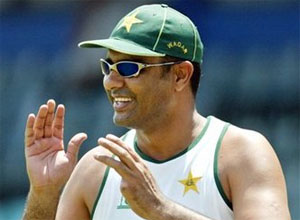
Waqar Younis
Waqar Younis
Waqar Younis

waqar younis wickets
WAQAR YOUNIS- THE REVERSE SWING KING!!!!!!!!

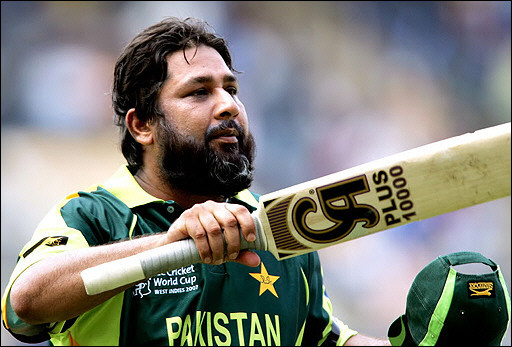
Inzamam-ul-Haq

Inzamam-ul-Haq Biography

Inzamam-ul-Haq (Saraiki, Punjabi, Urdu: انضمام الحق; born 3 March 1970[1]), also known as Inzy, is a Pakistani cricketer who was a leading batsman and the captain of the Pakistan national cricket team from 2003 to 2007. He is the second-highest run scorer for Pakistan in Test cricket, after Javed Miandad.
Inzamam rose to fame in the semi-final of the 1992 Cricket World Cup, in which he scored 60 off 37 balls against a strong New Zealand team.[2] His strong batting performance also propelled Pakistan to victory in the final of the 1992 Cricket World Cup. He remained one of the team's leading batsmen throughout the decade in both Test and ODI cricket. In 2003, he was appointed captain of the Pakistan team. His tenure as captain ended after Pakistan's early exit from the 2007 Cricket World Cup. On 5 October 2007, Inzamam retired from international cricket following the second Test match against South Africa, falling three runs short of Javed Miandad as Pakistan's leading run scorer in Test cricket. Following his retirement, he joined the Indian Cricket League, captaining the Hyderabad Heroes in the inaugural edition of the Twenty20 competition. In the ICL's second edition, he captained the Lahore Badshahs, a team composed entirely of Pakistani cricketers.
Inzamam-ul-Haq is a prominent member of the Tablighi Jamaat, an Islamic missionary organisation, and remains an influential personality in Pakistan cricket.

One Day International cricket
Inzamam made his One Day International (ODI) debut in a home series against West Indies in 1991, and made a good start to his career by scoring 20 and 60 runs in two matches against West Indies. This was followed by 48, 60, 101, and 117 runs against Sri Lanka.
Handpicked by former Pakistan captain Imran Khan for the 1992 Cricket World Cup in Australia and New Zealand, 22-year-old Inzamam was relatively unheard of before the tournament. To the surprise of many he was persevered with throughout the tournament, coming in at various positions in the batting line-up, despite not being very successful early on. Yet it was his performances at the most crucial stage of the competition that made fans and summarisers take note. Inzamam rose to fame in Pakistan's dramatic semi-final against New Zealand at Auckland. With his side in a precarious position, chasing 262 against an impressive New Zealand side, he hit a fiery 60 run innings from just 37 balls to rescue his side and guide them into the final.[3][4] The innings was regarded as one of the finest World Cup performances.[5] He hit a massive six in that match which was described by David Lloyd as the shot of the tournament.[citation needed]
Inzamam made an equally vital contribution in the final of the World Cup, scoring 42 runs off just 35 balls, helping Pakistan reach a score of 249 after a sluggish start.[6] These innings established Inzamam's billing as a big-game player, although he was unable to replicate his World Cup success in later tournaments.
Inzamam regard his best least highlighted innings of 90 not out against west indies when Pakistan won their first ODI in the West Indies on 27 March 1993.[7]
In total, Inzamam set a record for scoring the most half centuries in One Day Internationals, 83 – though this is now surpassed by Sachin Tendulkar.[8] He also became the second batsman to score 10,000 runs in One-day Internationals (again after Tendulkar) and was named in the ICC World XI for both Tests and One-day Internationals in the 2005 ICC Awards. In his final ODI for Pakistan, playing against Zimbabwe in the 2007 Cricket World Cup, he took three catches whilst fielding, including the last one of the match, ending his One Day career.[9]
[edit]Test cricket
Inzamam made his Test debut in 1992 against England at Edgbaston. However, he got little opportunity to make an impact in that match – he was not out with a score of 8. However, in subsequent matches he demonstrated vulnerability against swing bowling which resulted in him being dropped for the final Test of the series after averaging a lowly 13.20 runs per innings. Pakistan went on to secure a famous win in the match, taking the series 2–1.[10]
After the England series, Inzamam aimed to establish himself in the Test side and he achieved this brilliantly, helping his side to many memorable victories.[11] One of particular note came against Australia in Karachi, 1994, when he made 58 not out with the tail and helped Pakistan to a one-wicket victory and a 1–0 series win. As well as helping his side to become the top-ranked side in the world for a brief period. He achieved personal success by becoming ICC's number one ranked batsman in 1995[12] He later went on to reclaim top spot in the rankings in 1997. He remained amongst the top 20 ranked batsmen up until his retirement. He was the number one batsman in the world three times and held the title of the 3rd best batsman several times in his career including an extensive run from 2004–2006,[13] the last time being after his twin fifties at Lords against England in 2006.[14] The tour of England in 1996 was a particular success for both Inzamam and Pakistan, where Inzamam transformed his batting against seam bowling, averaging 64 runs per innings, with scores of 148, 70, 65, and 35.
His Test career highlights include 329 against New Zealand in Lahore in the 2001–02 season, which is the second highest Test score by a Pakistani and the twelfth highest overall. He also scored a century (184 runs) in his 100th Test, becoming only the fifth player to do so (after Colin Cowdrey, Alec Stewart, Gordon Greenidge and Javed Miandad; Ricky Ponting subsequently emulated the feat). Inzamam made a century in each innings of the second Test match against England in 2005, to become Pakistan's leading centurion with 24 centuries, breaking Javed Miandad's record. His 25th century in the 2nd Test against India on 22 January 2006 made him the 10th player to score 25 or more centuries. He also managed 138 not out when the team was on the brink of a humiliating defeat against Bangladesh, eventually saving the Test match and leading his team to victory. His 92 not out against South Africa in late 2006 again showed his ability to bat in a crisis in a match winning manner.[15] He scored twin half centuries when all appeared lost to draw the first test in Mohali against India in 2005,[16] and also scored 184 runs in his 100th test match[17] in the same away series causing the series to be drawn.[18] He still holds the record for most consecutive half centuries against a country with nine in nine innings against England. This streak started from 31 May 2001 and lasted till 13 July 2006.[19] He scored a century and a half century at Lords in 1996.[20] His 118 against Australia in Hobart almost won the test for Pakistan but Adam Gilchrist's match winning 149 not out made the difference.[21] His average in matches won is second only to Donald Bradman and Kumar Sangakkara.[22]
After announcing that he will retire after the second Test against South Africa, at the stadium where he made his international debut,[23] Inzamam needed 20 runs to surpass Javed Miandad for the record of most runs for a Pakistani Test cricketer.[24] After falling for 14 in the first innings, he was dismissed for 3 in his final innings by Paul Harris, out stumped,[25] leaving him three runs shy of the record. He needed only 70 more career runs for a batting average of 50.
[edit]County cricket
Inzamam made his debut in English county cricket in August 2007 at the age of 37. He joined Yorkshire County Cricket Club[26] as a replacement for Younus Khan who left to play for Pakistan in the 2007 ICC World Twenty20. He was disappointing on the whole, making eight on debut at Scarborough's North Marine Road against Warwickshire before making nine and seven in his opening Pro40 games.
[edit]Indian Cricket League
In 2007, Inzamam joined the unsanctioned Indian Cricket League. In the inaugural competition, Inzamam captained the Hyderabad Heroes and scored 141 runs in 5 matches. In the 2008 competition in March, Inzamam captained the Lahore Badshahs, composed entirely of Pakistani cricketers.
The move to the ICL has proved to be a controversial one for Inzamam. The PCB's stance on players joining unsanctioned leagues has meant that he has been banned from playing in any domestic competitions in Pakistan or any involvement with the international team.[27] However, given Inzamam's recent retirement, this is unlikely to affect him.
It is reported that he was paid Pakistani Rs. 10 Crore (US $1,100,000) which was the highest salary for any player participating in the league along with the likes of Brian Lara.
[edit]Playing style


I think Inzamam is as talented as Brian Lara and Sachin Tendulkar but little does he realise his true talent
— Former Pakistan captain Imran Khan.[28]
Inzamam has been known to be a very destructive batsman in both One Day Internationals (ODIs) and Test matches. He has the ability to pick the length of a delivery very early and play very late. His footwork is generally considered to be fast, enabling him to position himself early for shots. He averaged just under 50 runs per innings in Tests and nearly 40 runs in ODIs, with a strike rate of 54.03 and 74.23 respectively. Inzamam is especially strong when playing shots off his legs and has been considered to be amongst the best employers of the pull-shot in world cricket.
His batting style has brought him fans from all over the world. He was called "the best batsmen in the world against pace" by Imran Khan, because "he seems to have so much time on his hands before the ball reaches him".[citation needed]
Inzamam does, however, have a reputation for being a poor runner between the wickets. He has the dubious distinction of being run-out the second highest number of times in ODIs having been run-out 40 times [behind Marvan Atapattu (41 times)].
[edit]Captaincy


Inzamam captained Pakistan in thirty Tests, winning eleven, drawing nine and losing ten. Only three players have captained Pakistan in more Test matches, but all have better win-loss records and only Imran Khan has a lower win percentage than Inzamam. Although the Oval Test match in 2006 was poised as a victory for Pakistan before the controversy took place and had it not occurred, Inzamam's record would have had a win more and a loss less. However, Inzamam held the captaincy until March 2007, the longest captaincy tenure since 1992, when Imran Khan retired.
Captaincy had a positive effect on Inzamam's batting, often leading by example in pressure situations, averaging greater as a captain (52) than without (50). In ODI's Inzamam also held the highest average as captain in ODI's[29] and is currently third on that list behind the current Australian skipper Ricky Ponting and the Indian captain Mahendra Singh Dhoni. After early failures in Australia, he took a depleted Pakistan side to India in 2005 and played an important role in securing a draw by winning the final test match from an unlikely position with an innings of 184 runs. He subsequently lead his side to an ODI success against West Indies (away), England (home) and Sri Lanka (away) as well as Test Series victories against England (home), India (home), Sri Lanka (away). Inzamam had seemed to have united the Pakistan side and victories lead them to 2nd place in the ICC Test Rankings and 3rd place in the ICC ODI Ranking. The latter part of Inzamam's tenure as Pakistan captain was less successful and the team was embroiled in many controversies culminating in a disappointingly early exit from the 2007 Cricket World Cup at the hands of lowly ranked Ireland.
In the 2007 Cricket World Cup, Inzamam captained the Pakistani team to its first loss to associate ICC member Ireland (on St Patrick's Day). This result and their previous loss to West Indies, led to them being knocked out of the tournament. A day later he announced his retirement from One Day International Cricket and resignation as Test captain. The announcement was made the same day that Bob Woolmer, Pakistan's coach, died in his hotel room in Kingston, Jamaica. He dedicated his final ODI to Woolmer to whom he shared a good relationship with for three years and affectionately called 'The Bob'.
source:http://en.wikipedia.org/wiki/Inzamam-ul-Haq


Inzamam-ul-Haq
Inzamam-ul-Haq
Inzamam-ul-Haq
Inzamam-ul-Haq
Inzamam-ul-Haq
Inzamam-ul-Haq
Inzamam-ul-Haq
Inzamam-ul-Haq
Inzamam-ul-Haq

Inzamam-ul-Haq 100 vs INDIA 2004 Karachi
Inzamam ul haq - 1992 Semi Final

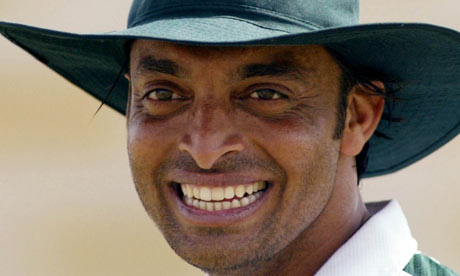
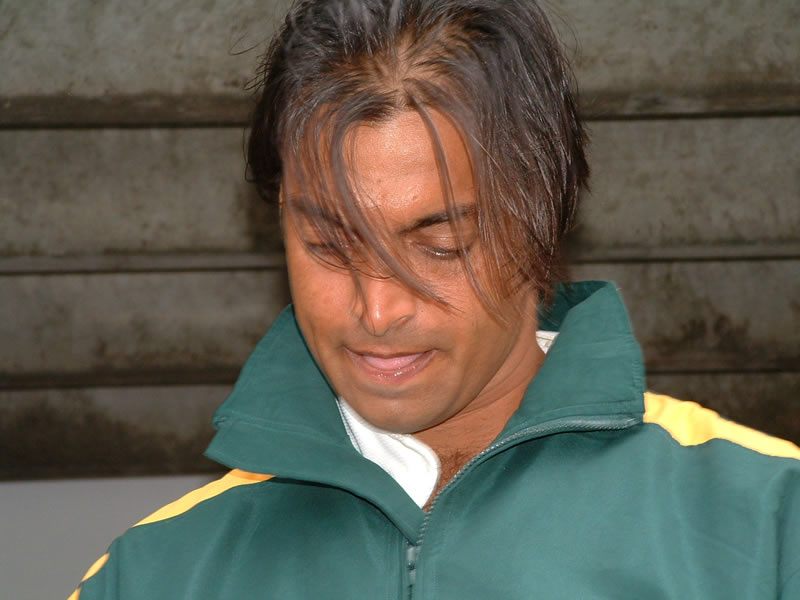
Shoaib Akhtar

Shoaib Akhtar Biography

Shoaib Akhtar (b. 13 August 1975) is a former Pakistani cricketer. One of the fastest bowlers in international cricket, he made his Test debut in November 1997 and played his first One Day International four months later.
He has been involved in several controversies during his career, often accused of not being a team player. Akhtar was sent home during the Test match series in Australia in 2005 for alleged poor attitude. A year later, he was embroiled in a drug scandal after testing positive to a banned substance. However, the ban imposed on him was lifted on court appeal. In September 2007, Akhtar was banned for an indefinite period for his fight with Pakistan team mate and fast bowler Mohammad Asif.[1] On 1 April 2008, Akhtar was banned for five years for publicly criticizing the Pakistan Cricket Board.[2] In October 2008, the Lahore High Court in Pakistan suspended the five year ban and Akhtar was selected in the 15-man squad for the Twenty20 Quadrangular Tournament in Canada.[3] Pakistani judge, Rana Bhagwandas stated once that, Akhtar is a legend of Pakistan cricket.[4] He retired from international cricket after the 2011 World Cup.

Early years

Akhtar was born at Morgah, a small town near Rawalpindi, Punjab in Pakistan.[5] His father was a plant operator in Attock Oil Refinery, Morgah.[5] Akhtar started his studies at Elliott High School, Morgah and then took admission in the Asghar Mall College, Rawalpindi.[citation needed]
[edit]Career

[edit]International career
Akhtar's run of impressive performances started in the 1990s. In 1999, during a pre-World Cup series against India, he rose to prominence. It was followed by outstanding bowling performances in Sharjah and later in 1999 Cricket World Cup. His most significant performance was in India in 1999 when he captured eight wickets in the Asian Test championship match at Calcutta – including the wickets of Indian batsman Sachin Tendulkar and Rahul Dravid off successive deliveries.
In 2002, he was selected for the Pakistan team against Australia and achieved success. However he performed poorly during the 2003 Cricket World Cup and after the tournament he was dropped from the Pakistan squad. He was selected back into the Pakistan squad in the 2004 Test match series against New Zealand, but struggled in a losing Test series against India in 2004. The series ended with a controversy when he left the field citing an injury leading to suspicions by former Pakistan captain, Inzamam-ul-Haq, about his commitment to the team. As a result, his relationship with Inzamam-ul-Haq and former Pakistan coach Bob Woolmer deteriorated. A medical panel was set up by the Pakistan Cricket Board to investigate the nature of his injury, however Pakistan officials dispelled all suspicions.[6]
In 2005, Akhtar regained his reputation as a fast bowler for his side. Playing in a three Test home series against England, he made a series of impressive bowling performances. His effective use of slower deliveries proved to be unplayable by the English batsmen. Akhtar emerged as the highest wicket taker of the series with seventeen wickets. His comeback was also remarkable as prior to his return, he had been criticized from all corners-such as by the Worcestershire chairman John Elliot for his celebrity attitude and lack of commitment to team. His performance was also acknowledged by the English captain Michael Vaughan, who remarked "I thought he (Shoaib) was a big difference between the two teams".[7] He is also known as the only bowler ever to break the 100 mph barrier in cricket bowling history, with a delivery of 100.2 mph, and this delivery at stands as the fastest recorded to date.[8]
[edit]Struggle for form and consistent injuries (2007–2009)
On 29 October 2007, Akhtar made his return to cricket, from his 13 match ban and performed well, taking 4 wickets for 43 runs against South Africa in the fifth and deciding One Day International series in Lahore in Pakistan. Subsequently, he was included in the 16 man Pakistan squad for the 2007 tour of India, which he completed successfully without further incident and injury.
[edit]Rehabilitation and final years (2010–2011)
Akhtar made a return to international cricket albeit in the shorter format of the game. In May 2010, PCB named him in a list of 35 probables for the Asia Cup. On 15 June 2010, Akhtar made his return, taking 3 wickets for 28 runs in the first match of the Asia Cup against Sri Lanka.[9] He narrowly missed out a spot in the 2010 ICC World Twenty20 in place of the injured Umar Gul.
In July 2010, he was selected for the Twenty20 series against Australia but the selectors decided not to play him in the Test squad so that he would not get injured. He was subsequently selected for the ODI and Twenty20 series against England in September 2010.[10]
Akhtar returned to the national side representing the country against England in the Twenty20 International. He bowled an impressive spell and returned with figures of 2 wickets for 23 runs.[11] He continued to bowl well in the ODI series in the absence of regular fast-bowlers, Mohammad Asif and Mohammad Amir, who were suspended by the International Cricket Council amid allegations of Spot-fixing. Despite his relatively good bowling form, Pakistani coach Waqar Younis insisted that the bowling attack must not become reliant on Akhtar, as he is 35 years of age and fitness troubles continue to affect him.[12] Akhtar was selected for the tour of New Zealand and started his campaign off well with 3 wickets on Boxing Day in the first of two Twenty20 Internationals against New Zealand.
Akhtar was selected in Pakistan's 15-man squad to play in the 2011 World Cup hosted by Bangladesh, India, and Sri Lanka in February to March. During the tournament, he announced that he would retire from international cricket at the end of the World Cup.[13] In September, Akhtar released his autobiography, Controversially Yours.[14]


Shoaib Akhtar signing an autograph for his fans.
Akhtar has played for three English county cricket clubs, including Somerset in 2001, Durham in 2003 and 2004 and Worcestershire in 2005. He did achieve his moments of success, such as taking 5 wickets for 35 runs for Durham against Somerset in the National League in 2003 and claiming 6 wickets for 16 runs in the same competition for Worcestershire against Glamorgan two years later, but he suffered from fitness problems, as well as a perception that he was less than interested in his task. This was particularly the case at Worcestershire: chairman John Elliott said "Players like that are no good to our club. In fact, Akhtar has been no good for any club he's been at. He's a superstar and just does what he wants."[15]
[edit]Indian Premier League
Akhtar made a successful return to cricket in his first game in the Indian Premier League, playing for the Kolkata Knight Riders against the Delhi Daredevils. Defending a low score of 133 runs, Akhtar took four top order wickets which ultimately led to the Daredevils being restricted to 110 runs. He ended with figures of 4 wickets for 11 runs from three overs, a performance which earned him the player of the match award.[16][17] Akhtar denied that he had any point to prove with his performance, stating, "I just wanted to win the game." Knight Riders' captain Sourav Ganguly also acknowledged Akhtar's performance, "He came to the country with lots [of things] happening behind him...But he showed a lot of character."[18] It has been widely reported that the Knight Riders have released Akhtar from his contract due to his injury history but the Knight Riders' officials have denied these reports and said they are still in talks with the fast bowler.[19]
He has also played for Cyclones of Chittagong in Bangladesh's NCL T20 Bangladesh.
[edit]Cricket controversies and injuries

Akhtar's career has been plagued with injuries, controversies and accusations of poor attitude. After rising into international stardom at a young age due to his speed, due to his interesting personality and charisma glamour seemed to follow him, some say at the detriment of his sporting focus. Although he eventually crossed the 100 mph barrier, his attitude took its toll on his reputation as well as his fitness. After a poor performance in the 2003 Cricket World Cup, he got involved in a verbal conflict with former Pakistan captain and fast bowler Waqar Younis. Later on Akhtar was sacked along with other players, including Younis. In a triangular series in 2003 held in Sri Lanka, he was caught tampering with the cricket ball, making him the second player in cricket to be banned on ball tampering charges. The same year he was banned for one Test match and two One Day International matches for abusing South African spin bowler Paul Adams, during a match against South Africa.
In the 2004 home series with India, he struggled with wrist and back injuries, which raised questions about their commitment to the team. His relationship with the captain and the coach deteriorated further partially due to team politics.
He was sent back from the 2005 Australia tour with a hamstring injury amid rumors of indiscipline, lack of commitment and attitudinal complaints. He was subsequently fined by the Pakistan Cricket Board for avoiding a late night curfew.[20] The rest of his cricketing career was riddled with ankle and knee injuries which forced him to undergo a surgery in February 2006, until finally he was banned for two years for allegedly using performance enhancing drugs.
In November 2006, an officer assigned to the Pakistan team in India, Anil Kaul, alleged that Akhtar had slapped former coach Bob Woolmer following a fight over the music to be played in the team bus on the eve of ICC Champions Trophy. Both Akhtar and Woolmer have strongly denied these allegations.[21]
[edit]Drug scandal
On 16 October 2006 Akhtar was suspended by the Pakistan Cricket Board, along with Mohammed Asif after the pair were tested positive for a performance-enhancing substance nandrolone.[22] They were consequently pulled out from the ICC Champions Trophy 2006.[23] Former Pakistan Cricket Board chairman later stated that he had always suspected Akhtar of substance abuse due to his consistent "reservations" to drug tests.[24] Former Pakistan captain Inzamam ul-Haq had also previously complained about Akhtar's drug abuse but was not reported to the Pakistan Cricket Board.[25] Pakistan news reports state that federal capital police had arrested Shoaib along with drugs some three years ago.
Akhtar immediately declared his innocence and he declined knowingly taking any performance enhancing drugs. In a statement issued to the press, he claimed that he could never cheat team-mates or opponents.[26] During a hearing with the Pakistan Cricket Board Anti-Doping Committee, he along with Asif maintained taking non-steroidal dietary supplements.[27] He, however, failed to convince the committee of his innocence. In its report submitted to the Pakistan Cricket Board and the Anti-Doping Committee recommended a two year ban.[28]
On 1 November 2006 the Pakistan Cricket Board handed down a two-year suspension to Akhtar and a one-year suspension to Asif, banning them from professional cricket during the period.[29] Shoaib had subsequently been added to Pakistan Olympic Association list of doping offenders.[30] However, on 5 December 2006 represented by his lawyer Abid Hassan Minto, Akhtar was cleared on appeal.[31]
[edit]Acquittal
On 5 December 2006 Akhtar and Asif were acquitted by the tribunal appointed to review their appeals against the drugs ban imposed on them by an earlier committee. After a clear hearing from Akhtar's lawyer Abid Hassan Minto, the three-man committee, headed by Justice Fakhruddin Ebrahim, voted two to one in favour of the acquittal. Haseeb Ahsan, former Test cricketer and Ebrahim were in favour of the acquittal while the third member, Danish Zaheer, dissented. "Exceptional circumstances" were cited including discrepancies between the instantaneous offence charges of doping that were laid and the quick delivery of a very harsh verdict. The complete drug testing procedure was concluded to have been technically flawed as it did not follow standard procedures. Other established facts by the committee included that the duo were not aware of the banned drug to be present in their supplements because the Pakistan Cricket Board itself had not informed them of the dangers of contaminated supplements.[32][33]
Both Akhtar and Asif were thankful to the Pakistan Cricket Board chairman Nasim Ashraf for giving them a fair trial and their team mates, captain and coach for the moral support. However, in 2006, they did not play in the Test match series against the West Indies because the Pakistan Cricket Board has recommended that they play domestic games first to recover form and fitness.[34]
However, WADA, the World Anti-Doping Agency was to challenge Pakistan's decision to lift bans on fast bowlers Akhtar and Asif by taking the case to the Court of Arbitration for Sport in Lausanne, Switzerland.[35] The ICC, cricket's world governing body, has supported the WADA appeal adding that it was committed to a dope free game.[36]
On 1 March 2007 Akhtar and Asif were ruled out of the Pakistani squad for the 2007 Cricket World Cup by team officials, minutes before the squad was to depart for the West Indies. The team management along with the Pakistan Cricket Board said their injuries were too severe to risk taking them to the Caribbean. Since neither of the two had been declared fit they had not undergone official doping tests.[37]
On 2 July 2007 the Court of Arbitration for Sport dropped the case, ruling it had no jurisdiction to challenge the decision made by PCB.[38][39]
On 21 May 2009, Akhtar was dropped from his country's World Championship Twenty20 squad because of genital viral warts, previously reported as a skin infection.[40]
[edit]Other controversies
In August 2007, Akhtar was reported to have used foul language against Pakistan Cricket Board protesting the imposing of fine of Rs. 300,000 for indiscipline during the national camp in Karachi.[41] In the week before the inaugural World Twenty20, held in South Africa, Akhtar was rumoured to have hit Pakistani team mate Mohammad Asif with a bat, leaving a bruise on his left thigh. According to sources, the two were involved in a dressing room spat which resulted in Asif being struck by a bat on his left thigh. Sources said the fight between the two started after Asif and Shahid Afridi disagreed with Shoaib that he shared the same stature as Imran Khan in Pakistan cricket and even ridiculed him for making such a comparison.[42] The injury was not thought to be anything more serious than a bruise but a team investigation into the matter was pending.[43] After the initial inquiry, it would found that Akhtar was at fault and he was subsequently recalled from the Twenty20 World Cup squad[44] and was sent home.[45] He was also banned for 5 matches by the Pakistan Cricket Board and a lifetime ban may also seem imminent.[46] Akhtar later claimed that Afridi was responsible for the fight, saying "He made some ill remarks about my family. And I could not tolerate them." Afridi however, denied these allegations adding that Asif would have suffered more injuries but for his intervention.[47] Even Asif chipped in saying that Akhtar was lying and that "Shahid Afridi had nothing to do with the fight." saying that "he has not apologised to me."[48] Akhtar later patched up with his team mates including Afridi and Asif
On 1 April 2008 Akhtar was banned for five years for violating the players' code of conduct. The ban extended to all cricket for and in Pakistan.[49] Despite the ban not preventing him from playing in the Indian Premier League, the IPL governing council decided not to allow Akhtar to play in the tournament until the end of the ban or unless it is lifted. IS Bindra, a member of the council, was quoted as saying, "Even though they [the PCB] have cleared him to play for IPL, we felt that international discipline needs to be respected."[50] Meanwhile, Akhtar vowed to go to great lengths to fight the ban, "I will appeal, as is my right. If that fails I will go to court, if that fails then I will go to the Supreme Court."[51] On 3 April, Pakistan Cricket Board chairman Nasim Ashraf served a legal notice on Akhtar, calling on him to retract statements he made to a news channel, alleging the ban was punishment in return for refusing to give the chairman a share of his earnings from the Indian Premier League, Ashraf also sought damages of Rs100 million (approximately US$1.6 million) for "defaming him personally" and an additional Rs100 million to the Pakistan Cricket Board for "sullying the name of the Pakistan Cricket Board and the Pakistan Cricket team."[52] A three-man appellate tribunal announced on 30 April that they had temporarily upheld Akhtar's five-year ban, deciding to revist the appeal hearing in June.[53] Despite Akhtar's later retracting his claims and also issuing an unconditional apology for "any grief or embarrassment that may have been caused to the nation, particularly to the Pakistan Cricket Board chairman Dr Nasim Ashraf", Ashraf's legal counsel filed a Rs22 crore (approx US$3.37 million) defamation suit against Akhtar in a civil court in Lahore on 2 May.[54] On 4 May, the Pakistan Cricket Board's appellate tribunal suspended the five-year ban for one month, until they reconvene on 4 June, allowing Akhtar to take part in the ongoing Indian Premier League.[55] A day later, the Pakistan Cricket Board announced that they will no longer pursue the defamation suit following a reconciliation between Akhtar and chairman Nasim Ashraf at the house of Rehman Malik, a key political official, in Islamabad. "My honour has been vindicated and now the defamation lawsuit will not be pursued," Ashraf was quoted as saying.[56]
On 4 September 2008, Akhtar was sent home by British immigration officials after landing at Heathrow airport without a valid working visa, authorities said he could not play without a working visa, though Akhtar had a valid visa to visit England but not a working visa, which is a prerequisite to play in county cricket. He subsequently obtained the necessary visa and returned to play with English county club Surrey.[57]
Akhtar also threatened to sue the Pakistan Cricket Board after it was revealed that he had contracted a sexually transmitted disease (genital warts) and thus dropped from the 2009 world Twenty20 championship.[58]

Shoaib Akhtar
Shoaib Akhtar
Shoaib Akhtar
Shoaib Akhtar
Shoaib Akhtar
Shoaib Akhtar
Shoaib Akhtar
Shoaib Akhtar
Shoaib Akhtar


Shoaib Akhtar at his Best
Shoaib Akhtar: The fastest bowler of all time. Pakistan

Javed Miandad

Javed Miandad Biography


Mohammad Javed Miandad Khan (Urdu: محمد جاوید میانداد) (born 12 June 1957), popularly known as Javed Miandad (Urdu: جاوید میانداد), is a former Pakistani cricketer who played between 1975 and 1996. He is Pakistan's leading run scorer in Test cricket. He has served as a captain of the Pakistan national cricket team. He is widely known for his big six against India in 1986 where 5 runs were required from 1 ball.[1] After his playing career, he has remained the coach of Pakistan cricket team at various occasions, as well as held positions in the Pakistan Cricket Board. He had three coaching stints with the Pakistan national team.

Early life
Javed Miandad was born in Karachi, Sindh in 1957. Javed Miandad attended schools and college in Karachi. His parents moved from Ahmedabad, Gujarat, India.[citation needed] Javed Miandad is a Tyagi (Muslim).[2]
[edit]
Career
Miandad made his Test debut against New Zealand at Lahore on 9 October 1976. He scored 163 in this match, to become the youngest player at the time to do so at an age of 19 years and 119 days.[3] In the same series he scored a double century, and on his way broke George Headley's 47 year record, to become the youngest player to achieve the feat.[4] Miandad made his One Day International debut against the West Indies at Edgbaston, Birmingham in the Cricket World Cup 1975. Interestingly, his last ODI was also a world cup match, in both innings he was run out and Pakistan lost the match. More, he scored 2 fours and 0 sixes and his strike rate was below 100 in both of his, first and last ODI innings.
Miandad's inclusion in the Pakistan team was itself an achievement. A formidable batting line-up of Majid Khan, Sadiq Muhammad, Zaheer Abbas, Asif Iqbal, Mushtaq Muhammad and Wasim Raja was hard to create any replacements, but Miandad's raw talent made it possible and he become an integral part of Pakistan's strong batting line.
Javed Miandad played 124 Test matches, batting in 189 innings. His aggregate of 8,832 Test runs is a Pakistani record. Even though his test career spanned 17 years, he failed to make it into the top-most category of batsmen with test aggregates of over 10,000 runs.[5] Miandad's 23 centuries and 43 fifties were Pakistani national records, until they were broken by Inzamam-ul-Haq. Miandad's Test career batting average of 52.57 is among the highest for Pakistani batsmen. He scored six double centuries which is the most by a Pakistani and 6th overall.He has honour of scoring centuries in both innings in the 1000th test match against New Zealand.[6] He made his highest score of 280 not out against India.
Javed Miandad is the first (and one of the only two, other being Sachin Tendulkar ) player to have played in six World Cups, the first six, from 1975 to 1996.
[edit]Coaching and commentary
As a coach, Javed Miandad guided Pakistan to test victories in the Asia Cup and in India during 1998-99 season, when Wasim Akram was captain. Miandad also later assisted with coaching Pakistani batsmen.[7]
Following this he was offered broadcasting and coaching positions in India.[8] Also in November 2010 it was being planned to give Miandad a role as a batting coach.[9]
[edit]
Personal life
Javed Miandad married Tahira Saigol in 1980. He has two sons and a daughter.[citation needed] He had three brothers play first-class cricket in Pakistan: Anwar, Sohail and Bashir. His son Junaid Miandad is married to Mahrukh Ibrahim daughter of India's most wanted alleged Don Dawood Ibrahim. Miandad told the press that his son and Ibrahim's daughter met while studying together in the UK.[10]
source:http://en.wikipedia.org/wiki/Javed_Miandad

Javed Miandad
Javed Miandad
Javed Miandad
Javed Miandad
Javed Miandad
Javed Miandad
Javed Miandad
Javed Miandad
Javed Miandad


Javed Miandad's Famous SIXER @ Sharjah
Javed Miandad last ball sixer

Saturday, 25 February 2012

Wasim Akram

Wasim Akram Biography

Wasim Akram (Punjabi: وسیم اکرم; born 3 June 1966) is a former Pakistani cricketer. He is a left arm fast bowler and left-handed batsman who represented the Pakistan national cricket team in Test cricket and One Day International (ODI) matches.
Akram is regarded as one of the best fast bowlers in the history of cricket. He holds the world record for most wickets in List A cricket with 881 and is second only to Sri Lankan off-spin bowler, Muttiah Muralitharan in terms of ODI wickets with 502. He is considered to be one of the founders and perhaps one of the finest exponents of reverse swing bowling.[1][2][3]
He was the first bowler to reach the 500-wicket mark in ODI cricket during the 2003 World Cup. In 2002 Wisden released its only list of best players of all time. Wasim was ranked as the best bowler in ODI of all time with a rating of 1223.5, ahead of Allan Donald, Imran Khan, Waqar Younis, Joel Garner, Glen McGrath and Muralitharan.
Wasim has taken 23 4-wicket hauls in ODI in 356 matches he played. On 30 September 2009, Akram was one of five new members inducted into the ICC Cricket Hall of Fame.

Early and personal life

Akram was born in Lahore, Pakistan on 3 June 1966, to a moderately affluent middle-class family.[5] He was educated at Islamia College in Lahore, where he played as an opening bowler and batsman.[5] Like several other Pakistani cricketers during the 1980s, his inclusion into the national side was at the behest of a senior player in the team, which in Akram's case, was Javed Miandad.[6]
Akram was diagnosed with diabetes at the peak of his career. Despite the initial psychological blow, he managed to regain his form and went on to produce fine cricketing performances. Since then he has actively sought to be involved in various awareness campaigns for diabetes.[7]
He married Huma in 1995. They had two sons Taimur and Akbar[8] from their marriage of fifteen years. Huma died of multiple organ failure at Apollo Hospital in Chennai, India on 25 October 2009.[9]
[edit]International career

[edit]First-class cricket
In 1988 he signed for Lancashire County Cricket Club in England and went on to become their most successful overseas players. From 1988 to 1998, he opened their bowling attack in their ECB Trophy, Benson and Hedges Cup and National League tournaments. He was a favorite of the local British fans who used to sing a song called "Wasim for England" at Lancashire's matches. In 1998, with Akram as captain Lancashire won the ECB Trophy and Axa League and finished second in the championship tournament despite losing only five matches in all competitions throughout the season. Apart from the National League second division title in 2003, this was the last time Lancashire won a trophy.[10]
[edit]Test cricket
Akram made his Test cricket debut for Pakistan against New Zealand in 1985 and in only his second Test match, he claimed 10 wickets. A few weeks prior to his selection into the Pakistan team, he was an unknown club cricketer who had failed to make it even to his college team. He came to the trials at Gaddafi Stadium in Lahore in Pakistan, but for the first two days he did not get a chance to bowl. On the third day he got a chance; his performance convincing Javed Miandad to insist upon his inclusion in the national team. Akram was hence given an opportunity to play for Pakistan, without any significant domestic experience. Later that season he opened the bowling attack with Imran Khan, who became his mentor at and after the World Championship of Cricket in Australia.
In the 1987 Cricket World Cup, when Pakistan played against the West Indies, Akram bowled to Viv Richards in the late overs of the innings but Richards, who is regarded as the best batsman during that period, struggled against Akram's bowling performances.
Akram's rise in international cricket was rapid during the late 1980s. When Pakistan toured the West Indies in 1988, he looked to be the fastest bowler between the two sides. However, a groin injury impeded his career in the late 1980s. Following two surgeries, he re-emerged in the 1990s as a fast bowler who focused more on swing and accurate bowling.
[edit]One Day International
Akram started his ODI career against New Zealand in Pakistan in 1984 under the Captaincy of Zaheer Abaass. He rose to prominence taking 5 wickets in his just 3rd ODI against an awesome Australian side in 1985 Benson & Hedges World Championship who would be future winners of 1987 World Cup.His wickets included that of Kepler Wessels, Dean Jones and Captain Border.
[edit]Rise to prominence (1983- Dec 1991)
In 1984-85 Rothmans Four-Nations Cup and 1985-86 Rothmans Sharjah Cup he took 5 wickets with a run rate of under 3.50, which was consided to be magnificent even in that times.He started improving his bowling with the passage of time taking help from Senior Pakistani member Imran Khan.
In 1985-1986 Austral-Asia Cup which involved Australia, India, New Zealand, Pakistan, Sri Lanka playing in UAE Sharjah. Wasim Akram with the help of Abdul Qadir destroyed New Zealand batting line up for just 64 in the Second Semi final of Cup.Pakistan won that game with more than 27 overs to spare obtaining one of the biggest wins in Pakistani history.In Final against India he and Imran(Captain at that time) shared 5 wickets between them. His scalps included Dilip Vengsarkar and Ravi Shastri.Akram was becoming the darling of swing in Sharjah. His bowls were at times difficult to read at the later half of innings making batsman busy in problems
In 1987 Reliance World Cup held for the 1st time in Sub Continent, Akram really struggled in Pakistani Pitches were he managed only 7 wickets with an average of 40+ in 7 matches. Akram played West Indies, Sri Lanka and England twice. All group matches were played in Pakistan.
In 1988-89 Benson and Hedges World Series he managed well 4-25 against powerful Australia.[1].He got his hundredth wicket at CA Sharjah in 1989-1990 Champions Trophy - 2nd Match against West Indies. His 100th wicket was of Ambrose.In that match he took 5 wickets only second time in his career.
On October 14, 1989 at Sharjah he took his 1st hat-trick against West Indies. All 3 batsman were bowled. Again on 4 May 1990in Sharjah, Akram took his second ODI hat-trick against Australia. All 3 batsmen were bowled this time also.[11] His best years in late 1980s were from 1986-1989 when which he took 100 wickets at 22.71 apiece and economy rate of less than 3.9 run/over with 4 4-wicket hauls. His first two 4-wicket hauls against Sri Lanka and Bangladesh came in bowler friendly conditions of Sri Lanka in 1986.[2].
Overall in this time period Akram rose from a young ordinary fast bowler to a dangerous wicket-taker who would move ball on any wicket he wanted to. Till Dec 1991 Akram took 143 wickets in 107 matches with an average of almost 24 and economy rate of 3.84. He took 5 4-wicket hauls. [3].
[edit]Career peak (Jan 1992- Dec 1997)
Akram was a significant figure in the 1992 Cricket World Cup held in Australia, when Pakistan won the tournament. In the final against England, his batting performance during his innings of 33 runs off 19 balls, pushed Pakistan to a respectable score of 249 runs for 6 wickets. Akram then took the important wicket of Ian Botham early on the English batting innings and when brought back into the bowling attack later on, with the ball reverse swinging, he produced a devastating spell of bowling which led to Allan Lamb and Chris Lewis being bowled in successive deliveries in one over. His excellent performances earned him the Man of the Match award for the final.[12][13] In 1993 Akram took 2 consecutive 4-wicket hauls against Sri Lanka in Sharjah in which 7 out of 8 wickets were either lbw or bowled.[4]. In 1992-1993 Total International Series in South Africa (Involving Pakistan, West Indies and South Africa) his magic was destructive where he took 5 wickets against South Africa and got his 200th wicket in 143rd match. He now emerged as a dangerous bowler in bowler friendly pitches of South Africa.[5].[6].Akram took 46 wickets in calender year 1993 certainly his best year ever in ODI.Another astonishment was average which was less than 19 with an economy rate of less than 3.8 runs / over. He took 6 4-wicket hauls in 1993 most by him in any year. This was the year when he and Waqar were truly mesmerizing.[7].In 1996 World Cup he struggled as he missed crucial quarter final match against India which Pakistan lost and went out of the World Cup. From 1994 till 1996 he took 84 wickets in 39 matches. This time period was his golden time
[8]. From Jan 1992 - Dec 1997 Akram played 131 matches took 198 wickets at mere 21.86 apiece with 14 4-wicket hauls in ODIs.Run rate was also fantastic with less than 3.8 per over. Definitely his best era in ODI cricket.[9].
[edit]A tough period with some joys (Jan 1998 till 2003 world cup)
In 1999, he led Pakistan to the brink of victory in the World Cup before they capitulated and was defeated by Australia in the final, by eight wickets with almost 30 overs to spare. This was the start of the match fixing controversies, as critics believed Akram had set up the match for Australia. However, none of the allegations could be proved.
He was Pakistan's best bowler in the 2003 Cricket World Cup taking 19 wickets in 6 matches. However, Pakistan failed to reach the "Super Six" phase of the tournament and Akram was one of the eight players to be sacked by the Pakistan Cricket Board as a result.
[edit]Records

He finished with 22 Man-of-the-Match awards in ODIs. In fact, Akram and Shaun Pollock (who also has 22) have the highest number of awards among players whose major suit isn't batting.[10]. In 199 ODI match wins, he took 326 wickets at under 19 apiece with a run rate of 3.70 and took 18 4-wicket hauls.[11].
[edit]Captaincy
Wasim Akram captained Pakistan in 109 ODI matches out of 356 he played. Pakistan won 66 matches of them. His win loss ratio of 1.60 puts him ahead of Imran Khan's1.27 and on par with Waqar Younis's 1.60. [12]. The high points of his captaincy was the 1996–1997 victory in the World Series Cricket in Australia, two Test match wins in India in 1998–1999 and in 1999, when Pakistan reached the 1999 Cricket World Cup final. The low point was the 1996 Cricket World Cup in Pakistan and India, when he had to pull out of the quarter final match against India, citing injury. After Pakistan's defeat, there were angry protests outside his home and riots across the country from angry fans who accused the team of throwing the match and a government inquiry was launched into the failure.
[edit]Retirement
On 18 May 2003, at the age of 36, Akram abruptly announced his retirement from international cricket, ending a career which spanned 19 years. He had suggested that he was ready to quit several times towards the end of his career, but Pakistan's sub-par performance in the World Cup proved to be the deciding factor.
Prior to his retirement, he was one of eight senior players dropped for the Sharjah Cup in April 2003, and was then omitted from the Pakistan squad for the subsequent Bank Alfalah Cup triangular series.[14] Due to his omission from the team, he did not participate in a farewell match.
Akram fulfilled his contract play for Hampshire until the end of the English season.
[edit]Post retirement

[edit]Media career
Since retiring from cricket, Akram has worked and taken up commentary for television networks and can currently be seen as a sports commentator for ESPN Star Sports and ARY Digital among others. He did commentary on a variety of sporting tournaments including the 2009 Women's Cricket World Cup in Australia, the 2009 ICC World Twenty20 in England, the 2009 ICC Champions Trophy in South Africa, and the 2011 ICC World Cup in India, Sri Lanka and Bangladesh.
[edit]Coaching career
In 2010, Akram was appointed the bowling coach consultant of Kolkata Knight Riders, the Indian Premier League team for Kolkata. Sourav Ganguly was always keen to have Akram as the bowling coach for India, during the former's stint as Indian captain. Although this never happened, his dreams were realised to some extent, when Akram was appointed as the bowling coach for the franchise.[15] While working for the Kolkata Knight Riders, he was also responsible for the signing of Pakistani domestic left-arm fast-bowler Mohammad Irfan.[16] Akram has also been coaching in Pakistan fast bowling camps, his most notable discovery being the teenage Pakistani bowler Muhammad Amir.
[edit]Skills in cricket

Over my 15 or 16 years of playing international cricket in Tests and One Day Internationals, Wasim Akram is definitely the most outstanding bowler I've ever faced.
— Former West Indies batsman Brian Lara.[17]
During his professional career he bowled with genuine speed and hostility. Akram was a man possessed of accurate control of line and length, accompanied by seam and swing bowling skills, extended to both inswingers and outswingers. With a very quick bowling action, he could bowl equally well from both sides of the wicket. His mastery of reverse swing with the cricket ball meant he was at his most dangerous towards a bowling innings, and earned him the nickname of one of the "Sultans of Swing", the other one being Waqar Younis.
As well as often being able to find the edge of the bat, Akram would also focus his bowling attack on the stumps and had a particularly lethal inswinging yorker. Of his 414 Test wickets, 193 were taken caught, 119 were taken leg before wicket and 102 were bowled.[18][19][20] In partnership with Waqar Younis, he intimidated international batsmen in the 1990s. Together Wasim and Waqar, known as "the two Ws" of the Pakistani team, were one of the most successful bowling partnerships in cricket.[21]
Akram was also skilled with the bat and was regarded as a bowling all-rounder. He was especially effective against spin bowlers. However, he liked to slog and was criticised for his lack of high scores and giving away his wicket too cheaply for a player of his talent. He did silence his critics and the media in October 1996 when he scored 257 runs not out, of the team's total of 553 against Zimbabwe at Sheikhupura. He also achieved good scores for the Pakistan team such as his scores of 123 and 45* against Australia to take Pakistan to victory in a low scoring match. His batting was also valuable to the Pakistan ODI side, such as his match winning performance in the Nehru Cup, when needing six runs and two balls to win the match; he hit the first delivery he faced for six runs and secured the cup.
[edit]Modeling
Akram walked the ramp at the Pantene Bridal Couture Week 2011 which was an event of Style 360.[22][23]
[edit]Award and records

See also: List of international cricket five-wicket hauls by Wasim Akram
Akram was awarded Wisden Cricketer of the Year in 1993 for his sporting achievements. He was awarded Lux Style Award for Most Stylish Sports Person in 2003.
In his Test career, Akram took 414 wickets in 104 matches, a Pakistani record, at an average of 23.62 and scored 2,898 runs, at an average of 22.64.[24]
In One Day Internationals, Akram took 502 wickets in 356 appearances, at an average of 23.52 and scored 3,717 runs, at an average of 16.52.[2]
Akram was the first bowler in international cricket to take more than 400 wickets in both forms of the game and only Muttiah Muralitharan has since achieved this.[2][24]
Akram also held the record for the most wickets in Cricket World Cups, a total of 55 in 38 matches. Australia's Glenn McGrath broke the record during the 2007 Cricket World Cup, ending with a final tally of 71 from 39 matches.[25] On passing Wasim's record, McGrath said, "Wasim Akram, to me, is one of the greatest bowlers of all time. Left-armer, swung it both ways with the new ball and he was so dangerous with the old ball. To go past him is something I will always remember. Probably the other side of the coin is that if you play long enough, you're going to break records here and there."[26]
Akram took four hat-tricks in international cricket, two each in Tests matches and One Day Internationals. He is the only bowler in cricket to have achieved four hat-tricks. He was the third of only three bowlers to have taken two Test cricket hat-tricks, the others being Hugh Trumble and Jimmy Matthews. Akram was also the first of only five bowlers to have taken two One Day International cricket hat-tricks. Akram's Test hat-tricks are significant, since they were taken in consecutive Test matches in the same series, a game played against Sri Lanka in the 1998-99 Asian Test Championship. Akram is also one of only two bowlers to have taken both a Test match and One Day International hat-trick, the other being Pakistan fast bowler, Mohammad Sami.[27][28]
Playing in a Test series against the West Indies at Lahore in 1990–1991, he became one of only six players to have taken four wickets in an over during a Test match. In Akram's case, these achievement was not part of a hat-trick, the third ball he delivered to the batting opposition was a dropped catch, which allowed a single run.[29][30]
Akram has also achieved the highest score by a number eight batsman in Test cricket when he scored 257 runs not out from 363 balls against Zimbabwe at Sheikhupura. The innings contained 12 sixes which is also a world record for Test cricket.[31][32]
He also has the third highest number of Man of the Match awards in Test cricket, with seventeen.[33]
He has scored the record number of runs in One Day International matches by a player who has never scored a One Day International hundred. His highest score was 86 runs.[34]
[edit]Cricket controversies

In 1992, after he had been successful against the English batsmen, accusations of ball tampering began to appear in the English media, though no video evidence of foul play was ever found. Akram and Younis had been able to obtain prodigious amounts of movement from both new and old cricket balls. The skill of the reverse swing delivery was relatively unknown in England and around the cricketing world during that period.
A far larger controversy was created when critics alleged that he was involved in match fixing. An inquiry commission was set up by the Pakistan Cricket Board headed by a Pakistan high court judge, Malik Mohammad Qayyum. The judge wrote in his report that:[35]
This commission feels that all is not well here and that Wasim Akram is not above board. He has not co-operated with this Commission. It is only by giving Wasim Akram the benefit of the doubt after Ata-ur-Rehman changed his testimony in suspicious circumstances that he has not been found guilty of match-fixing. He cannot be said to be above suspicion.
source:http://en.wikipedia.org/wiki/Wasim_Akram

Wasim Akram
Wasim Akram
Wasim Akram
Wasim Akram
Wasim Akram
Wasim Akram
Wasim Akram
Wasim Akram
Wasim Akram

Wasim Akram : The Greatest bowler of all time. Pakistan
Wasim Akram- The King Of Swing !!

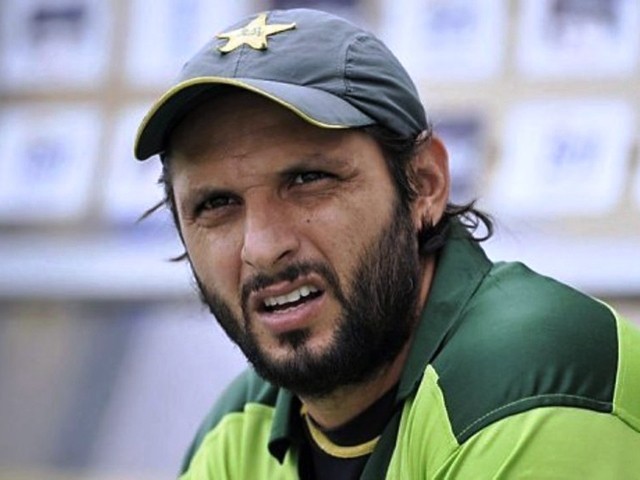
Shahid Afridi

Shahid Afridi Biography

Sahibzada Mohammad Shahid Khan Afridi (born 1 March 1980 in Khyber Agency), popularly known as Shahid Afridi, is a Pakistani cricketer currently playing for the Pakistani national team in the international circuit. He made his ODI debut on 2 October 1996 against Kenya in Nairobi[1] and his Test debut on 22 October 1998 against Australia at Karachi.[2] He is known for his aggressive batting style, and currently holds the highest career strike rate in the history of international cricket. In a recent survey, Afridi was named as the most popular cricketer in Pakistan.[3] He also holds the record for the fastest one day century which he made in his debut innings, as well as scoring 32 runs in a single over, the second highest scoring over ever in an ODI.


Style


His general style of batting is very aggressive and attack oriented and has earned him the nickname “Boom Boom Afridi” for his fastest One Day International century just in 37 balls. As of 22 May 2007, he has an ODI strike rate of 109.38 runs per 100 balls, the highest in the game’s history. This attitude has been transferred to Test cricket as well, with Afridi scoring at a relatively high strike rate of 86.13 in Tests. He has an approach to batting that can change the tempo of a game and inspire the mood of an audience, as shown when a mass exodus of spectators occurred in Pakistan in late 2005 following his dismissal from the crease. He hits many sixes long and high, favoring straight down the ground or over midwicket. A trademark shot is a crossbatted flick to the leg-side to a ball outside off stump.[8]. This explosive style has led to some memorable shots, most notably the first ever 12 in power cricket in 2002, where Afridi successfully hit the roof. [9] However, his aggressive style increases his risk of getting out and he is one of the most inconsistent batsmen in cricket. This is reflected by the fact that he is the only player to score more than 5000 ODI runs at an average under 25.


Bowling-wise, his stock ball is the leg break, but his armory also includes the conventional off break and a ‘quicker one’ which he can deliver at nearly 80 mph in the style of a medium-pacer. He bowls at a high speed for a spinner, resulting in lesser turn, and relying more on variations in speed. He occasionally sends down a bouncer to a batsmen, which is very rare for a spin bowler.


International career


In October 1996 at the age of sixteen he was brought into the ODI team as a legspinner as a replacement for the injured Mushtaq Ahmed. He then gained notability as a pinch-hitter and began opening with Saeed Anwar. He holds the record for scoring the fastest century in one-day internationals (off 37 balls)[12], scored in only his second match and his first ODI innings. He also shares with Brian Lara the record for the third-fastest century in ODIs (off 45 balls). One of Pakistan’s most useful all-rounders, he has an extremely aggressive batting style, which has garnered him over 5,000 ODI runs (including an erstwhile world-record 249 sixes, recently broken by Sanath Jayasuriya), as well as taking over 250 wickets at ODI and 47 at Test level.


For various reasons, including a perception that he lacks patience in his batting, Afridi had limited opportunity in Test matches, although he currently averages in the high thirties and mid-thirties with bat and ball respectively. As it is, Afridi has featured in less than one third of the Test Matches played by Pakistan over the course of his career.[13] However, he made his presence felt in the third Test against India in March 2005, scoring a quick-fire second-innings half-century and taking five wickets in the match (including Tendulkar twice) to help Pakistan to win the game and register a series draw.


It is perceived that his batting struggles on bouncy pitches and against opponents like Australia, although his record against the Australians has improved over time. Although he has had success as an opener on sub-continent pitches, Afridi is often moved into the lower order as well.


Afridi was more consistent with his batting and bowling throughout 2005, starting with the tours of India and West Indies and through to the England tour. The Pakistani coach Bob Woolmer helped Afridi to reach a fuller potential by improving his shot selection and giving him free rein over his batting attitude.


In the 2007 World Twenty20, he performed poorly with the bat but brilliantly with the ball, earning the Man of the Series award, though he failed to take a wicket in the final and was out for a golden duck.


Career Highlights


* On 4 October 1996, playing his maiden international innings, Afridi hit the fastest One-Day century off 37 balls against Sri Lanka in Nairobi. His innings included 28 runs off one of Sanath Jayasuriya’s overs, whose record he broke. [15]


* Youngest player in history to make an ODI century at just 16 years and 217 days with his 37 ball ton against Sri Lanka. It included 11 sixes and 6 fours. [16]


* Made a half-century from 26 balls and took 3 second-innings wickets in Pakistan’s series-drawing Test victory against India in March 2005.[14]


* Holds the joint record with Brian Lara for the third fastest ODI century off 45 balls in April 2005 against India. [17] This actually was the first match that witnessed the Indian cricketer-turned-commentator Ravi Shastri make him the nickname Boom Boom Afridi.


* Equal highest aggregate sixes scored in the 50-over game, shared the legendary Sri Lankan batsman Sanath Jayasuriya, and he the most sixes per innings record.


* Scored four consecutive sixes off a Harbhajan Singh over in a Test match against India in January 2006, matching a feat that Kapil Dev achieved in 1990.


* Was the first player to score 12 runs off one ball, by hitting the roof of the Millennium Stadium. This took place in a game of Power Cricket.[citation needed][clarification needed]


* Holds four of the top eight fastest ODI half centuries, twice completed in 18 balls and twice in 20 balls. He has also scored a half century off just 21 balls.


* Made 32 runs off a Malinga Bandara over in an ODI game at Abu Dhabi in 2007. He struck four consecutive sixes and it was the 2nd most expensive over in ODI history.


* Afridi is only third player in ODI history to achieve the combination of 5000 runs and 200 wickets. The other players being Sri Lankan batsman Sanath Jayasuriya and South African Jacques Kallis.


source:http://urdunews.wordpress.com/2009/06/15/shahid-afridi-biography-sahibzada-mohammad-shahid-khan-afridi/

Shahid Afridi
Shahid Afridi
Shahid Afridi
Shahid Afridi
Shahid Afridi
Shahid Afridi
Shahid Afridi
Shahid Afridi
Shahid Afridi

Shahid Afridi 'The Match Winner' 51 & 2-16 vs South Africa 2009 T20 World Cup Semi Final
Shahid Afridi 25 (12) Balls vs India 2004 ICC Champions Trophy